

Sustainability · 2025
In this section50 topics
- Sustainability Policy4 items
- Sustainability Goals & UN SDGs3 items
- Policy Review3 items
- Business Value Chain1 item
- Stakeholder Analysis2 items
- Environmental Policy & Guidelines3 items
- Environmental Policy Review3 items
- Energy — Plan & Guidelines2 items
- Energy — Electricity Consumption1 item
- Energy — Fuel Consumption1 item
- Energy — Targets2 items
- Energy — Performance & Outcomes2 items
- Water — Plan & Guidelines2 items
- Water — Withdrawal, Discharge & Consumption1 item
- Water — Targets2 items
- Water — Performance & Outcomes2 items
- Waste — Plan & Guidelines2 items
- Waste — Generation, Disposal & Recycling1 item
- Waste — Targets2 items
- Waste — Performance & Outcomes2 items
- GHG — Plan & Guidelines3 items
- GHG — Emissions1 item
- GHG — Emissions Verification2 items
- GHG — Principles & Standards1 item
- GHG — Targets1 item
- GHG Targets — Other Targets2 items
- GHG — Performance & Outcomes2 items
- Environmental Legal Incidents2 items
- Other Environmental Management1 item
- Social Policy & Guidelines4 items
- Social Policy Review2 items
- Human Rights Due Diligence4 items
- Employees — Plan & Guidelines3 items
- Employees — Workforce3 items
- Employees — Remuneration & Provident Fund2 items
- Employees — Training & Development2 items
- Employees — Occupational Health & Safety2 items
- Employees — Labour Relations2 items
- Employees — Employee Representation2 items
- Employees — Targets1 item
- Employees — Performance & Outcomes2 items
- Customers — Plan & Guidelines3 items
- Customers — Satisfaction Results1 item
- Customers — Targets2 items
- Customers — Performance & Outcomes2 items
- Community & Social — Plan & Guidelines3 items
- Community & Social — Targets1 item
- Community & Social — Performance & Outcomes2 items
- Other Social Management1 item
- Law Violation Incidents2 items
Sustainability Policy
Has a Sustainability Policy
Yes
Policy Description
Based on the company's vision, "Global leader in sustainable gas cylinder business with innovative spirit for better lives." the Board of Directors recognizes that achieving added value, growth, and sustainable success requires a balance across all dimensions—economic, environmental, and social—under the principles of corporate governance, business ethics, respect for human rights, and stakeholder participation throughout the value chain. The board also takes into account the stakeholders under ethics, good corporate governance, and sufficiency economy principles by His Majesty King Bhumibol Adulyadej the Great Borommanat Bophit. The Late King once gave a speech to the Thai people in 1974: to live under the principles of moderation, reasonableness, and immunity on the condition of "knowledge" and "morality". It was integrated with the company's business ethics and operating policies through the most efficient and effective activities.
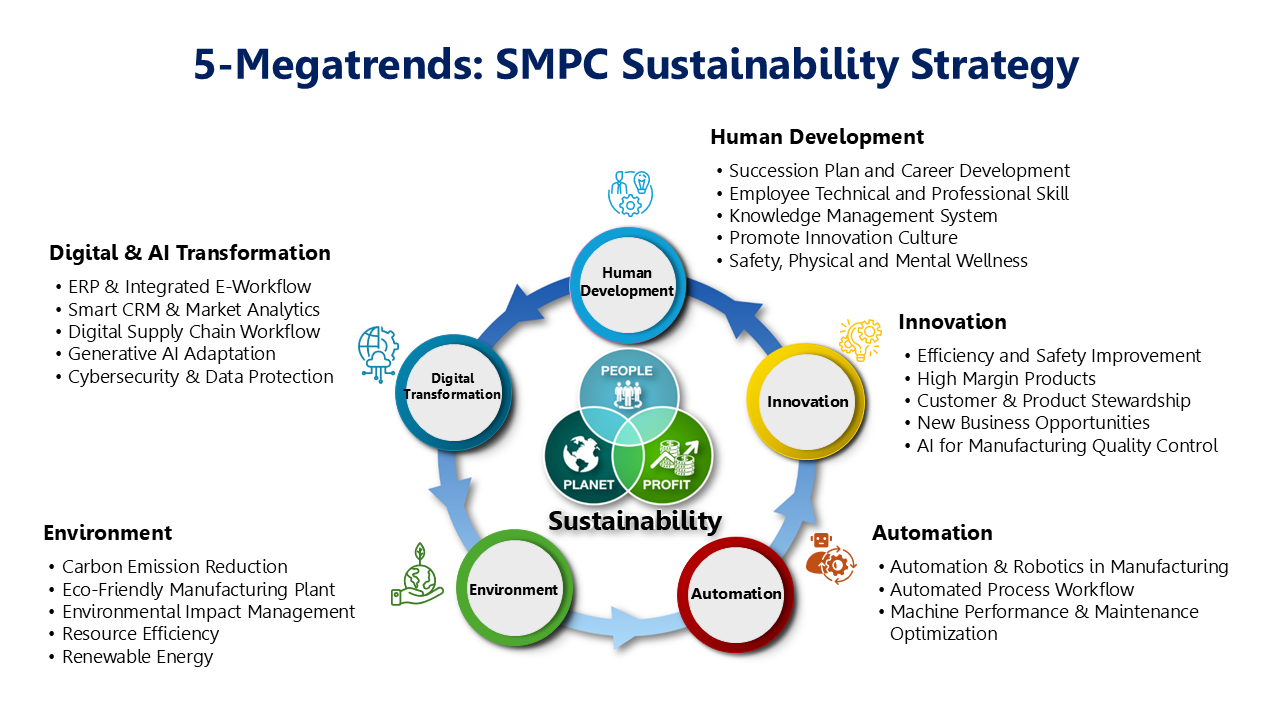
The company has integrated these principles into its vision, mission, and business context, considering stakeholders and key sustainability issues throughout the value chain. This has resulted in concrete sustainability strategies and operational guidelines to support the United Nations, Sustainable Development Goals (SDGs). The company has established a sustainability policy as a framework for all units, integrating it into the value chain from raw material sourcing, production, delivery, sales and marketing, to after-sales service. This aims to create positive outcomes for People-Planet-Profit through five business sustainability strategies (5 Megatrends Towards Future Sustainability for SMPC) and key sustainability issues such as efficient resource and energy use, water and wastewater management, waste reduction, separation and reuse, pollution and greenhouse gas reduction, development of innovative, safe, and environmentally friendly products and services, enhanced workplace safety and human rights, capacity building for employees and communities, supplier governance, and creating transparent and verifiable value for customers and shareholders.
Policy Document Link
https://www.smpcplc.com/sustainability_management_en/
Page Number in Report
1
Sustainability Goals & UN SDGs
Has Sustainability Goals
Yes
Goals Description
3.1.1 Human Development
Human resources are the key for driving the organization and are an important force in leading the company to grow sustainably. The company therefore focuses on creating a working environment that supports learning, skill development, and enhancing the potential of employees at all levels. The company is committed to develop employees to be leaders who have both business ability and a good ethics towards society.
The company places importance on comprehensive personnel development by organizing training both internally and externally. The company also creates an organizational culture that promotes learning, opens to the exchange of ideas, encourages employees to innovate and bring new technology to apply in work, and supports employees from various departments to work together on projects and activities to develop teamwork in order to strengthen cooperation between parties and increase operational efficiency. As a result, there are development of working process, production process and new products and services that meet market needs. In addition, the company also carries out a project to develop successors and plan career paths to promote employees' career advancement. The company also cultivates awareness of responsibility towards society, community and the environment through activities that create employee participation. Hence, employees aware of their roles as important members of the organization and society. It also helps strengthen feelings of connection and pride in growing together with the company sustainably.
In terms quality of life, the company also takes care of employees to have a good quality of life, providing them with fair compensation and welfare. Employees have occupational health and safety at work. Moreover, human rights are considered as an important principle, whether it is a matter of rights, liberties, or equality, including the fair protection.
3.1.2 Digitization of working processes
The company has developed a process to work into digital systems in order to support a new normal work and life, hence more up to date and flexible. The company has established a policy to bring more digital systems to manage the company's supply chain by implementing e-document and e-workflow to development working process, hence more convenience and les redundant. As a result, the company is able to respond to customer needs more quickly and reduce the use of resources. Besides, the company has further developed its digital capabilities by implementing technology for connecting and retrieving data between systems. This reduces redundant work and manual data entry, minimizing errors and processing time. The company has also developed internal applications to support the workflows of various departments, ensuring employees work according to the same standards and continuously monitoring process status. In addition, the company has upgraded and modernized its core information systems, coupled with the development of a centralized database that links data across departments. This reduces data redundancy and supports more accurate and reliable data analysis for management decision-making.
The company is also aware of the importance of the security of its information systems, so a structured system is put in place to protect information securely on the network, as well as testing and inspecting the information security system to prevent unauthorized access to information. The company also focus on the personal information management by strictly compliance with the Personal Data Protection Act to protect the rights and freedoms of employees and stakeholders for all.
3.1.3 Environmental Management
The company places importance on conducting business along with continual care for the environment. The company has adopted the ISO 14001: 2015, environmental management system as direction for operation, along with creating environmental policies, organizing activities and projects to instill in employees’ awareness and importance of the environment. The company has brought digital systems to work to reduce the natural resource usage. Besides, developing production processes to reduce waste generation and environment impact, including using a wet scrubber system in the production process can prevent the fumes and dust generated by the production process not to be emitted into the air, hence no effect on the environment. The silencers are also used in the production process. The company installed a sound suppressor and soundproof walls to reduce the noise generated by factory operations. Growing trees around the fence is to create a green area and also a sound proof. The company treats and reuses 100% of the water used in its production processes.
SMPC also takes into account the climate change that the world is facing, thus the company determined to operate its business with environmental responsibility. A working team has been established to manage the carbon footprint of the organization to set goals and guidelines for reducing greenhouse gas emissions. The company has reduced the use of electricity and used renewable energy from the solar rooftop power generation system instead, hence reducing greenhouse gas emissions, resulting in sustainable environmental protection. Please see more details about the operation in the topic 3.3 Sustainability management in the environmental dimension.
3.1.4. Automation
The company has kept up with new technologies, and developed the production process continuously. The company has used robotic and automated production line systems into the production process, hence more consistent of the quality of work, more production efficiency, and less waste. The company also expands automation system in other processes, i.e., production plant and office station. Please see more details about the operation in the topic 1.2.2.1 Product or service characteristics and business innovation development.
3.1.5. Innovation
For the company to have sustainability, one of the factors is to innovate and create new innovations in products, services, working system and production process, to be able to reach and meet the needs of customers. In creating company innovation, the company takes into account the needs of customers, society, and environment by bringing opinions and problems of customers and stakeholders to develop products and services. For example, applying RFID to be used with LPG cylinders, this enables customers to record and utilize the information in various ways, including the circulating the cylinder, inventory management, traceability, etc. In addition, the company has developed the new product made from aluminum materials to meet the needs of customers who want lightweight cylinders, which are convenient to use and move, and difficult to get rusty. And at the end of its lifespan, the material can be 100% recycled.
Apart from using the innovations for products and services, The company has provided employees with opportunities to contribute to organizational development through presentation platforms, fostering collaborative efforts to improve efficiency and innovation within the organization. This has led to the adoption of innovation in production processes. There is research and development to improve the production process, adopting technology to stabilize production, making the best use of resources effectively and safely. Please see more details about the operation in the topic. 1.2.2.1 Characteristics of products or services and the development of business innovations.
UN Sustainable Development Goals
| SDG Goal |
|---|
| Goal 3 Good Health and Well-being |
| Goal 4 Quality Education |
| Goal 5 Gender Equality |
| Goal 6 Clean Water and Sanitation |
| Goal 7 Affordable and Clean Energy |
| Goal 8 Decent Work and Economic Growth |
| Goal 9 Industry, Innovation and Infrastructure |
| Goal 10 Reduce Inequalities |
| Goal 11 Sustainable Cities and Communities |
| Goal 12 Responsible Consumption and Production |
| Goal 13 Climate Action |
| Goal 16 Peace, Justice and Strong Institutions |
Policy Review
Policy Reviewed This Year
Yes
Policy Changed This Year
No
Review Details
Policies, goals, and guidelines for business sustainability in 5 areas (5 Megatrends Towards Future Sustainability for SMPC) were reviewed at the Corporate Governance and Sustainability Development Committee meeting No. 2/2024 on December 23, 2024, and the results were reported to the Board of Directors meeting No. 6/2024 on December 23, 2024 for implementing the sustainability in 2025. Environmental policies, goals, and actions for 2025 Environmental Implementation were reviewed and announced for execution through the Environmental Management System Team Meeting No. 1/2025 on February 19, 2025.
Business Value Chain
Value Chain Description
The Board of Directors emphasizes on the importance of all stakeholders, and has set out guidelines on stakeholder engagement equally and fairly in the business code of conduct. The guidelines were distributed to all employees since start working with the company. The company also takes care of stakeholders' rights according to related laws, and shall not perform any activity that would violate the stakeholders' rights.
Stakeholder Analysis
Introduction
In 2025, the company has reviewed participation of stakeholders along with identifying and assessing the importance of stakeholders, which relating to the operations of the company covering all business chains. The company also found ways to respond effectively and appropriately to the expectations and issues that stakeholders place importance on. In assessing the importance of stakeholders, the company has evaluated from 2 factors: the influence of stakeholders on the company, and the stakeholder interest in the company.
There are 6 groups of stakeholders of the company, ranked in order of importance according to the influence of stakeholders on the company, and interests of stakeholders to the company, namely shareholders, customers, employees, partners, competitors, and communities and the environment. The first 3 groups of stakeholders are the main stakeholders that the company will closely operate and manage.
Moreover, the company values the opinions and participation of all groups of stakeholders. The company therefore has different forms of communication and channels for stakeholder participation in each group, to allow all groups of stakeholders to participate and express their opinions transparently and appropriately. The details are as shown in the stakeholder analysis below.
Assessment of Key Sustainability Issues
The company conducts an annual assessment of key sustainability issues related to its business operations, covering environmental, social, governance, and economic (ESG) dimensions. This assessment considers the impact in both dimensions according to the Double Materiality principle, comprising:
1. Impact Materiality: This assesses the positive and negative impacts, both past and future, on society and the environment, based on the company's operations and the expectations of stakeholders throughout the value chain.
2. Financial Materiality: This considers the sustainability risks and opportunities that may affect the company's performance, development, and financial results.
The company takes into account issues relevant to its business operations, as well as those aligned with the expectations of all stakeholder groups throughout the business value chain, using the Double Materiality assessment process of the European Union's Corporate Sustainability Reporting Directive (CSRD). The European Sustainability Reporting Standards (ESRS), developed by the European Financial Reporting Advisory Group (EFRAG) and based on the principles of the Global Reporting Initiative (GRI) Standards, reflect factors influencing business operations in the environmental, social, governance, and economic aspects. Key sustainability issues are assessed as follows:
1. Identifying Impacts Throughout the Value Chain
The company identified key sustainability issues relevant to its business operations, considering internal and external factors within the business context, economic and social environments, and regulatory frameworks, as well as the needs and expectations of all stakeholder groups, to define the scope of issues that may have both current and future impacts.
2. Assessing the Company's Impact on the Environment and Society (Impact Materiality)
The company assessed the positive and negative impacts of its operations on the environment, society, and economy (from an internal to an external perspective).
3. Assessing the Impact on Business and Finances (Financial Materiality)
The company assessed which sustainability issues impact its long-term performance, financial status, and ability to create value, in terms of both risks and opportunities (from an external to an internal perspective).
4. Prioritization
The company prioritized the key issues identified in Step 1, considering the opportunities and severity of each issue's impact on economic, social, and environmental value creation.
5. Reviewing Issues
The prioritized issues were presented to the management team for review of the organization's key sustainability issues. The completeness, accuracy, and comprehensiveness of significant issues were verified to ensure coverage of all dimensions: economic, social, and environmental.
Results of the Assessment of Key Sustainability Issues
The company reviewed the assessment of key sustainability issues. The issues were prioritized based on input from stakeholders, internal and external factors affecting stakeholders and the company. Each issue has different levels of sustainability importance in the economic, environmental, and social dimensions. In 2025, the company identified key business issues, which were approved by the Board of Directors, as follows:
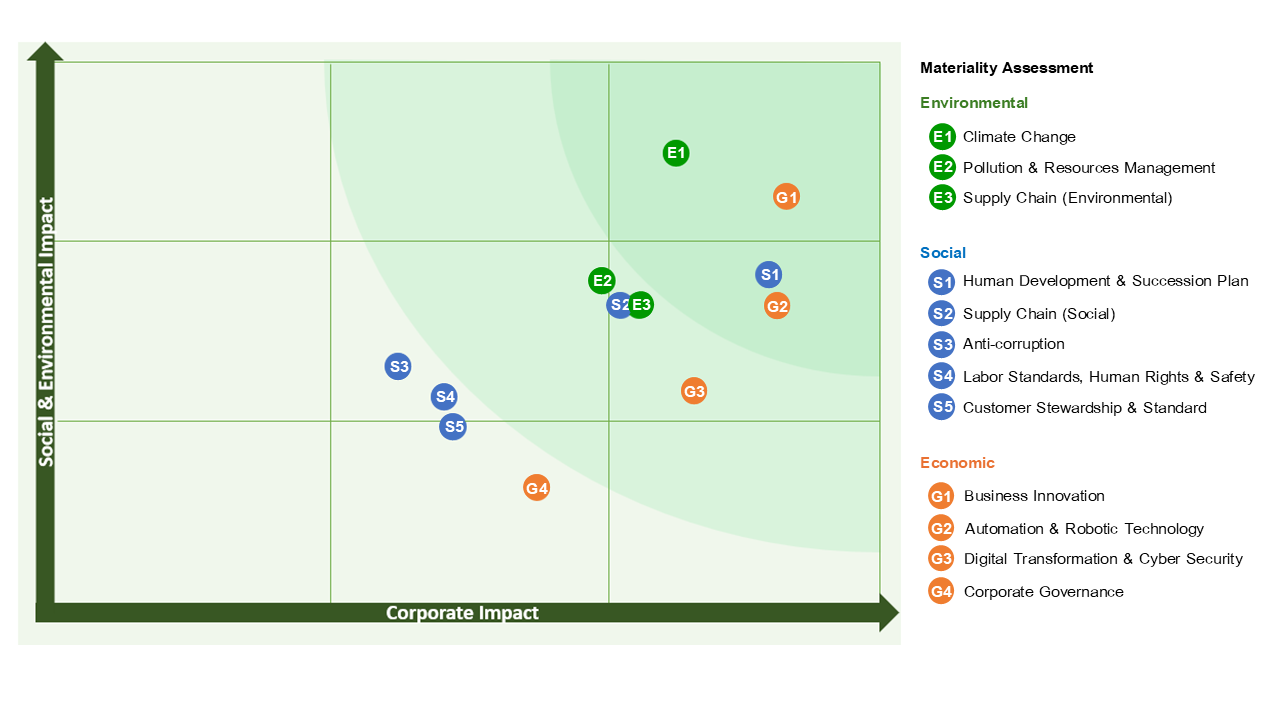
Based on the prioritization of key sustainability issues for 2025, there are 12 issues that are important to stakeholders and to the company:
Environmental Dimension
1. Climate Change Management
2. Pollution & Resources Management
3. Supply Chain Environmental Impact Reduction
Social Dimension
1. Human Development & Succession Planning
2. Supply Chain Social Responsibility
3. Labor Standards, Human Rights & Safety
4. Anti-corruption
5. Customer Stewardship & Product Standards
Economic Dimension
1. Business Innovation
2. Automation & Robotic Technology
3. Digital Transformation and Cyber Security
4. Corporate Governance
Dimensions | Key Issues | Management Directions | Capital Value | Impact on the company | Alignment with Sustainability Reporting Standards (GRI) | SDGs |
Environment | 1. Climate change management |
Measures to reduce greenhouse gas emissions. | Natural Capital |
Reduce the environmental impact of business operations on internal and external stakeholders | GRI 305: Emission |
|
Environment | 2. Waste management and natural resource reduction |
Managing resources to ensure optimal utilization | Natural Capital Financial Capital |
lower electricity costs.
| GRI 306: Waste GRI 307: Environmental Compliance Energy Saving GRI 302: Energy Water Management GRI 303: Water and Effluent |
|
Environment | 3. Reducing environmental impacts in the supply chain |
| Natural Capital Manufactured Capital Financial Capital |
Meets the needs of customers that prioritize low-carbon products and services | GRI 305 Emissions |
|
Social | 1. Developing the capabilities of personnel and planning for succession. |
| Human Capital Financial Capital |
| GRI 404: Training and Education GRI 201: Economic Performance |
|
Social | 2. Social responsibility in the supply chain |
| Social & Relationship Capital Human Capital Financial Capital |
| GRI 204: Procurement Practices GRI 414 Supplier Social Assessment |
|
Social | 3. Labor standards, human rights, and safety. |
| Human Capital Social & Relationship Capital Financial Capital |
| GRI 401 Employment GRI 405: Diversity and Equal Opportunity GRI 403: Occupational Health and Safety |
|
Social | 4. Anti-corruption |
| Financial Capital Human Capital Social & Relationship Capital |
| GRI 205 Anti-corruption |
|
Social | 5. Responsibility to customers and product standards |
| Financial Capital |
| GRI 416: Customer Health and Safety GRI 418: Customer Privacy |
|
Economic | 1.Developing business innovations |
| Financial Capital Intellectual Capital Manufacturing Capital |
| GRI 201: Economic Performance |
|
Economic | 2. Improving work efficiency through automation |
| Manufacturing Capital |
| GRI 201: Economic Performance |
|
Economic | 3. Digital Transformation and Cybersecurity |
| Manufacturing Capital Financial Capital |
| GRI 201: Economic Performance |
|
Economic | 4. Corporate Governance |
| Human Capital Financial Capital |
| GRI 102: Governance |
|
















Stakeholder Analysis
| Stakeholder Type | Stakeholders | Stakeholder Expectations | Response to Expectations | Communication Activities |
|---|---|---|---|---|
| External stakeholders | 2913 · Description: Shareholders | • Good and sustainable performance
• Good Corporate Governance
• Risk control planning
• Information disclosure and transparency
• Equitable treatment of stakeholders | • Aim to create maximum benefits for shareholders with efficient planning and operation.
• Cost management, by developing and reducing production costs to the lowest under the specified standards, without affecting the quality of the product.
• Conduct business in accordance with good governance principles, and good corporate governance
• Policy and plan for risk management.
• The necessary information is disclosed to the public.
• Treat investors and all stakeholders equally.
• Study and consider investment in various projects continually | 2941 · Description: Online Communication · 2943 · Description: External Meeting · 2944 · Description: Annual General Meeting (AGM) · 2949 · Other name: Annual Report · Description: Others · 2949 · Other name: Investor Relation Contact Tel. 02- 895-4139-54 · Description: Others · 2949 · Other name: Email: ir@smpcplc.com · Description: Others · 2949 · Other name: Website: www.smpcplc.com · Description: Others |
| External stakeholders | 2923 · Description: Customers | • The product is safe. The quality meets the required standards.
• Delivery on time
• Fair price, able to compete
• Quickly support and solve problems for customers.
• Conduct business efficiently with international standard. Does not affect the community, society and environment.
• Development of product and services. | • Accredited to the standards of each country. Product quality control is conducted at each stage of production, as well as being audited by external auditors as required by customers
• Develop production and work processes in order to be able to produce products quickly according to the customers’ need.
• Develop new product according to market need.
• Deliver good quality of products on time
• Maintain responsibility and accountability to customers and products.
• Maintain good product quality continuously
• Before and after sale services with engineers and experts to give advice to customers.
• There are systems and mechanisms in place to respond and act quickly to solve problems and complaints of customers, as well as to take care of and prevent repeating the same problems.
• Accredited by international standards of ISO 9001 and ISO 14001. Operate with responsibility towards communities, society and the environment.
• Business Review by jointly planning and reviewing business strategies with customers. | 2938 · Description: Visit · 2941 · Description: Online Communication · 2943 · Description: External Meeting · 2947 · Description: Satisfaction Survey · 2949 · Other name: Contact sales and marketing Tel: 02-895-4139-54 · Description: Others · 2949 · Other name: Email: marketing@smpcplc.com · Description: Others · 2949 · Other name: Website: www.smpcplc.com · Description: Others |
| Internal stakeholders | 2921 · Description: Employees · 2922 · Description: Expatriate · 2936 · Other name: Note: Employees mean permanent staffs, daily staffs, temporary staffs, and contractual staffs. · Description: Others | • Reasonable compensation and benefits.
• Knowledge development, and work skills.
• Strong with good progress in work.
• Good working environment and safety at work
• Employee treatment with humanity principles.
| • Fair remuneration and welfare, along with paying bonuses according to the company's performance each year.
• Support, develop, and increase the knowledge, abilities and skills of employees to have a good, consistent and secured career path.
• Provide opportunities for employees to showcase their potential and contribute to organizational development through platforms for presenting process improvement initiatives to enhance efficiency and innovation across the organization.
• Plan career progression and succession planning.
• Take care of the working environment to be safe for life, health and property of employees.
• Respect for human rights without discrimination, race, religion, gender, social or political opinion.
• Take comments and suggestions from employees to develop and improve employee care.
• Development and improvement of work processes into digital systems
• Provide scholarships to children of employees who meet the specified criteria.
| 2941 · Description: Online Communication · 2942 · Description: Internal Meeting · 2945 · Description: Complaint Reception · 2946 · Description: Employee Engagement Survey · 2948 · Description: Training / Seminar · 2949 · Other name: Comment or complaint through various channels by contacting HR, executives or directors or informing via comment box or Email: cs@smpcplc.com · Description: Others |
| External stakeholders | 2899 · Description: Suppliers | • Transparency and fairness
• A clear procurement regulation.
• The company complies with the contract or agreed terms
• Growing business together. | • Conduct business in accordance with anti-corruption policy, no receiving any benefits from business partners and treating them equally.
• Invite business partners to join in the anti-corruption.
• Follow up the compliance with the Supplier Code of Conduct, which covers social and environmental issues.
• Analyze and assess trading partner risks
• Provide them with information of the procurement process
• Strictly abide by the agreed contracts.
• Share knowledge and jointly develop products with partners
• Support environmental friendly procurement
• Business Review by jointly planning and reviewing business strategies with partners. | 2938 · Description: Visit · 2949 · Other name: Contact Purchasing Department Tel. 02- 895-4139-54 · Description: Others · 2949 · Other name: Complaints about corruption through email: cs@smpcplc.com · Description: Others |
| External stakeholders | 2898 · Description: Competitors | • Fair trade
• Do not damage reputation or accuse
• Cooperate to develop and drive the market to grow | • Compete in a framework of fair rules and do not seek confidential information by unjust means
• Do not damage the reputation of competitors by defamation or any act without truth and fairness
• Develop and drive the industry to grow continuously | 2949 · Other name: Tel: 02-895-4139 · Description: Others · 2949 · Other name: Complaints about corruption through email: cs@smpcplc.com · Description: Others |
| External stakeholders | 2902 · Description: Community · 2936 · Other name: environment · Description: Others | • Support the community to have a good quality of life, free from environmental problems
• Create jobs, support, provide assistance and cooperate with people in the community
• Conduct business with social and environmental responsibilities | • Carry out environmental management Control and reduce environmental impacts from business operations
• There is employment, support, assistance, and cooperation with people in the community.
• The company has continued to create benefits for communities, society and the environment, both self-operating and cooperating with government and community
• Implement projects and activities to reduce greenhouse gas emissions.
• Improve working processes to move to the Paperless working system. | 2940 · Description: Social Event · 2945 · Description: Complaint Reception · 2949 · Other name: Contact HR or the Environmental Complaint Center Tel: 02-895-4139 · Description: Others · 2949 · Other name: Email: em@smpcplc.com · Description: Others |
Environmental Policy & Guidelines
Has an Environmental Policy
Yes
Policy Description
The policies are as follows:
To ensure that all functions relating to the operations/manufacturing are environmental friendly.
To prevent accidents and to control waste discharge to be below the acceptable level, or in line with the related laws.
To be responsible and uphold the protection of environment and also the local culture and tradition where the company operate.
To promptly and effectively respond to any incident impacting the environment and community from the company's operations by providing full cooperation to the government officers and related organizations.
To not perform any activity that would harm the overall natural resources and environment.
Committed to development for environmental protection, pollution prevention, and the optimal use of natural resources.
Instilling environmental awareness in employees
Environmental Guidelines
| Guideline |
|---|
| Electricity Management |
| Fuel Management |
| Water Management |
| Waste Management |
| Greenhouse Gas and Climate Change Management |
| Air Quality Management |
| Noise Pollution Management |
Environmental Policy Review
Policy Reviewed This Year
Yes
Review Details
Environmental policies, practices and targets are part of the company's sustainability policies. They were reviewed at the Corporate Governance and Sustainability Development Committee meeting No. 2/2024 on December 23, 2024. The results were reported to the Board of Directors' meeting No. 6/2024 on December 23, 2024 for use in implementing sustainability in 2025. For the environmental policies, goals, and actions for 2025 were reviewed and announced for implementation through the Environmental Management System Team Meeting No. 1/2025 on February 14, 2025.
Policies & Guidelines Changed
| Change |
|---|
| Electricity Management |
| Fuel Management |
| Renewable/Clean Energy Management |
| Water Management |
| Waste Management |
| Biodiversity Management |
| Greenhouse Gas and Climate Change Management |
| Air Quality Management |
| Noise Pollution Management |
Energy — Plan & Guidelines
Has an Energy Management Plan
Yes
Plan Description
The company has managed to achieve the most useful and efficient use of energy. Each year, the company and the Environment Management System Committee have set goals and implemented measures to reduce electricity consumption.
Energy — Electricity Consumption
Electricity Consumption
| Metric | Current Year | Previous Year | Two Years Ago |
|---|---|---|---|
| Total electricity consumption within the organization (Kilowatt-Hours) | 21,044,000 | 22,593,477 | 17,445,384 |
| Electricity purchased for consumption from non-renewable energy sources (Kilowatt-Hours) | |||
| Electricity purchased or generated for consumption from renewable energy sources (Kilowatt-Hours) |
Energy — Fuel Consumption
Fuel Consumption
| Metric | Current Year | Previous Year | Two Years Ago |
|---|---|---|---|
| Crude oil (Barrels) | |||
| Coal (Metric tonnes) | |||
| Jet fuel (Litres) | |||
| Diesel (Litres) | 38,563.24 | 39,515 | 36,105 |
| Gasoline (Litres) | 6,250.98 | 4,717 | 4,297 |
| Fuel oil (Litres) | |||
| Natural gas (Standard cubic feet) | |||
| LPG (Kilograms) | 3,487,342 | 3,572,780 | 2,883,940 |
| Steam (Metric tonnes) |
Energy — Targets
Has Set Targets
Yes
Targets
| Target | Base Year | Base Year Value | Target Year | Target Year Value | Target Change (%) | Unit |
|---|---|---|---|---|---|---|
| Reduction of electricity purchased and fuel consumption | 2,024 | 22,512,000 | 2,025 | 21,706,070.4 | 3.58 | Kilowatt-hour |
Energy — Performance & Outcomes
Has Performance Results
Yes
Performance Description
The company's electricity consumption in 2025, compared to 2024, shows an overall decrease of 6.52%. Electricity consumption per unit of production also decreased by 6.52% due to lower production volumes in 2025 compared to 2024. However, the company continues its energy conservation campaigns and has increased inspections for leaks at various points, such as leaks in the compressed air and pneumatic systems of the factory. The company has implemented the following activities to promote electricity reduction:
The activities to promote the reduction of electricity
Changing light bulbs to be energy-saving ones.
Regular maintenance of machinery and equipment
Using renewable energy from the sun by installing a solar power generation system (Solar Rooftop)
Increase the efficiency of the Air Compressor to replace the old one with low efficiency and install Central Air Compressor.
Improve the insulation of the wall and door of furnace and improve paint furnace to reduce energy loss
Reduce the leakage rate of compressed air systems.
Water — Plan & Guidelines
Has a Water Management Plan
Yes
Plan Description
The company manages for efficient water use, by reducing water consumption, and water loss, and managing water quality. Each year, the company and the environmental management system committee have set goals and actions to reduce water usage.
Water — Withdrawal, Discharge & Consumption
Water Withdrawal, Discharge & Consumption
| Metric | Current Year | Previous Year | Two Years Ago |
|---|---|---|---|
| Total water withdrawal (Cubic meters) | 28,760.53 | 27,641 | 19,452 |
| Total water withdrawal by third-party water (Cubic meters) | 11,999.53 | 14,633 | 10,132 |
| Total water withdrawal by surface water (Cubic meters) | |||
| Total water withdrawal by groundwater (Cubic meters) | |||
| Total water withdrawal by seawater (Cubic meters) | |||
| Total water withdrawal by produced water (Cubic meters) | 16,761 | 13,008 | 9,320 |
| Percentage of wastewater treated before discharge (%) | |||
| Total water discharge (Cubic meters) | |||
| Total water discharge to third-party water (Cubic meters) | |||
| Total water discharge to surface water (Cubic meters) | |||
| Total water discharge to groundwater (Cubic meters) | |||
| Total water discharge to seawater (Cubic meters) | |||
| Total water consumption (Cubic meters) | 28,760.53 | 27,641 | 19,452 |
| Recycled water (Cubic meters) |
Water — Targets
Has Set Targets
Yes
Targets
| Target | Base Year | Base Year Value | Target Year | Target Year Value | Target Change (%) | Unit |
|---|---|---|---|---|---|---|
| Reduction of water withdrawal | 2,024 | 27,640.57 | 2,025 | 27,640.57 | 0 | Cubic meters |
Water — Performance & Outcomes
Has Performance Results
Yes
Performance Description
The Company’s tap water consumption in 2025 increased by 4.05% compared to 2024. The primary factor contributing to the overall increase was the implementation of enhanced cleaning measures prior to product export, as well as increased cleaning frequency of production lines to elevate quality and safety standards. Nevertheless, the Company continued to implement water conservation campaigns and initiatives on an ongoing basis and strengthened measures to monitor potential water leakage. The Company carried out the following activities to promote the reduction of tap water consumption as follows:
Activities to promote the reduction of water usage
100% recycled water used in the production process. The company has treated water with the filterred and disinfected process.
Expand the amount of water to be able to accommodate more water to be recycled.
Store rainwater in a reserve pond to be used in the production process.
Consistently check leakage points of water pipes within the factory to reduce waste.
Roll out campaign and instill awareness in water usage among employees and increase channels for reporting water leakage.
Waste — Plan & Guidelines
Has a Waste Management Plan
Yes
Plan Description
The company has managed garbage and waste both hazardous and non-hazardous. The company has promoted waste management and separation. There is information on garbage and waste management operations as follows.
Waste — Generation, Disposal & Recycling
Waste Generation, Disposal & Recycling
| Metric | Current Year | Previous Year | Two Years Ago |
|---|---|---|---|
| Total waste generated (Kilograms) | 1,586,564.95 | 1,635,329 | 1,213,770 |
| Non-hazardous waste (Kilograms) | 1,248,822.95 | 1,284,736 | 944,354 |
| Non-hazardous waste - Landfilling (Kilograms) | |||
| Non-hazardous waste - Incineration (with energy recovery) (Kilograms) | |||
| Non-hazardous waste - Incineration (without energy recovery) (Kilograms) | |||
| Non-hazardous waste - Other disposal operations (Kilograms) | |||
| Hazardous waste (Kilograms) | 337,742 | 350,593 | 269,416 |
| Hazardous waste - Landfilling (Kilograms) | |||
| Hazardous waste - Incineration (with energy recovery) (Kilograms) | |||
| Hazardous waste - Incineration (without energy recovery) (Kilograms) | |||
| Hazardous waste - Other disposal operations (Kilograms) | |||
| Total reused/recycled waste (Kilograms) | 1,051,652.95 | 1,105,794 | 775,490 |
| Reused/Recycled non-hazardous waste (Kilograms) | 984,412.95 | 1,006,916 | 717,864 |
| Reused non-hazardous waste (Kilograms) | |||
| Recycled non-hazardous waste (Kilograms) | |||
| Reused/Recycled hazardous waste (Kilograms) | 67,240 | 98,878 | 57,626 |
| Reused hazardous waste (Kilograms) | |||
| Recycled hazardous waste (Kilograms) |
Waste — Targets
Has Set Targets
Yes
Targets
| Waste Type | Disposal Approach | Target | Base Year | Base Year Value | Target Year | Target Year Value | Target Change (%) | Unit |
|---|---|---|---|---|---|---|---|---|
| Hazardous waste | 2763 · Other name: Hire an external specialist company for elimination · Description: Other | Reduce waste volume | 2,024 | 350,593 | 2,025 | 350,593 | 0 | Kilograms |
| Non-hazardous waste | 2763 · Other name: Hire an external specialist company for elimination · Description: Other | Reduce waste volume | 2,024 | 1,284,736.35 | 2,025 | 1,284,736.35 | 0 | Kilograms |
Waste — Performance & Outcomes
Has Performance Results
Yes
Performance Description
In 2025, 78.83% of garbage and non-hazardous waste is utilized by recycling. For the hazardous waste, the company has installed a zinc dust collector box in the production line. This makes it 19.91% reusable and recyclable. The company has activities to promote waste and waste management as follows
Activities to promote garbage and waste management
The company has provided suitable waste containers, separated waste and stored each type of waste in an orderly manner.
The company has built a contaminated waste shed and disposed of with a standardized company when there is an appropriate amount.
The company has implemented the “Waste Bank Project” as part of the company's 5S activities, which the company has continued to implement the project. All employees in the company participated in this activity.
GHG — Plan & Guidelines
Has a GHG Management Plan
Yes
Plan Description
The company realizes the importance of climate change and global warming. Risks from climate change affects the company's business operations. The company therefore places importance on reducing greenhouse gas emissions, in response to government and private sector policies both domestically and internationally that focuses on reducing greenhouse gas emissions. The company has established a working team of carbon footprint management, conducting an assessment of the company's greenhouse gas emissions. By setting the year 2021 as the base year. There were a data verification process, data storage, and the measure of the amount of greenhouse gas emissions to a standard. In 2025, the company has hired ECEE Company Limited to be a verifier of the organization's greenhouse gas emissions. This was the information between 1 January 2024 and 31 December 2024. The company was certified Carbon Footprint for Organization from Thailand Greenhouse Gas Management Organization (Public Organization).
Plan Document Link
https://www.smpcplc.com/th/environmental_management_th/
GHG — Emissions
GHG Emissions
| Metric | Current Year | Previous Year | Two Years Ago |
|---|---|---|---|
| Total GHG emissions (Metric tonnes of carbon dioxide equivalent) | 23,074 | 24,057 | 19,111 |
| Total greenhouse gas emissions 1 (Metric tonnes of carbon dioxide equivalent) | 12,574 | 12,803 | 10,428 |
| Total greenhouse gas emissions 2 (Metric tonnes of carbon dioxide equivalent) | 10,500 | 11,254 | 8,683 |
| Total greenhouse gas emissions 3 (Metric tonnes of carbon dioxide equivalent) |
GHG — Emissions Verification
Emissions Verified by a Third Party
Yes
Verifying Body
2645
GHG — Principles & Standards
Principles & Standards Applied
| Standard |
|---|
| 2671 |
GHG — Targets
Has Set GHG Targets
Yes
GHG Targets — Other Targets
Introduction
1. Direct greenhouse gas emissions (Scope 1)
Caused by the combustion of various fuels, both from machines and from company-owned vehicles such as combustion from the use of LPG, gasoline and diesel, etc. It is also from Carbon dioxide emissions from the production process, use of refrigerants and the use of chemicals in the wastewater treatment system.
2. Indirect greenhouse gas emissions from energy use (Scope 2)
Caused by using the company's electricity.
Other GHG Targets
| Emission Scope | Base Year | Base Year Emissions | Near-term Target Year | Near-term Target Value | Near-term Target Change (%) | Target Year | Target Year Emissions | Target Change (%) | Unit |
|---|---|---|---|---|---|---|---|---|---|
| 2716 | 2,021 | 23,420 | 2,025 | 28,960.16 | 1.8 | 2,025 | 28,960.16 | 1.8 | Metric tonnes of carbon dioxide equivalent |
GHG — Performance & Outcomes
Has Performance Results
Yes
Performance Description
By 2025, the company aims to reduce greenhouse gas emissions by 1.80% compared to 2024. In 2025, the company's total greenhouse gas emissions are projected at 23,074 tons of carbon dioxide equivalent, a decrease of 4.09% compared to 2024. This reduction is primarily due to decreased electricity consumption. However, the company remains committed to continuous efforts to reduce greenhouse gas emissions through plans to improve the efficiency of production processes and reduce energy consumption, in order to achieve its future emission reduction targets.
Environmental Legal Incidents
Introduction
In 2025, the company did not receive any whistle blowing or complaints about the environment regarding to production process and operation of the company. In addition, the company has not had any environmental disputes in the past year.
The company is committed to conducting business with an emphasis on sustainability and effective environmental management. More details in Topic 3 “Driving Business for Sustainability”
Legal Violation Incidents
| Metric | Current Year | Previous Year | Two Years Ago |
|---|---|---|---|
| Number of cases or incidents of legal violations or negative environmental impact (cases) | 0 | 0 | 0 |
Other Environmental Management
Plan Description
1. Air quality management
The company has controlled the rate of exhaust fumes accordance with standards specified by law. Each year, the company and the Environment Management System Committee have set targets and have implemented air pollution management. The goals and operations are as follows.
Target: Pass the criteria for measuring the amount of pollutants released from the chimney as required by law.
Measurement results: Passed the criteria
Performance and results of air quality management
Activities to promote air quality management
SMPC decreases the dust internally before releasing the air out to the community around the factory, by having the outsource company to bring the vacuum cleaner to daily vacuum in the plant.
The wet scrubber system is used in the production process. So that the fumes and dust generated by the production process are not emitted into the air, hence less effect to the environment.
The related departments regularly monitor the quality of air, also have audit and maintenance plan for the machinery and equipment.
Measures to check the water curtain, water spray and dust filter of the Wet Scrubber.
2. Working environment management
The company measures noise, light and heat levels to provide employees and operators with a good working environment. The company also prevents danger, take care the well-being of operators by setting goals with operational working as follows:
Target: Pass the criteria of noise level and lighting measurement as required by law
Measurement results: Passed the criteria
Additional workplace environmental management performance and results
Level of noise.
SMPC consistently monitors level of noise according to the required law to ensure of no noise pollution to the community. Wind noise reduction devices (Silencers) is used in the production process. The company also installed soundproof wall, noise barrier tunnel, soundproof room for grinding, a cover room for water and powder spraying blower, cover room for Zinc and sandblasting blower to reduce noise caused by the factory operation. Planting trees around the factory fence is used as a soundproof wall. SMPC also considers other additional directions to prevent and manage the noise pollution in order not to affect the health of employees in the factory as well as communities in nearby areas. For the employee, the company also have noise protection, such as ear plug, and ear muff for the employees who work in the environment at risk of noise pollution. The employees also are encouraged to wear personal protection equipment (PPE). The company organizes to have the hearing test on top of the annual medical checkup, for the employees who work in the loudly noise area.
Lighting.
The company manages to have the illumination measurement in the working area at least once a year, so that employees get to work with enough lighting, good working environment. This also to prevent accident while working.
Heat.
SMPC arranges the heat measurement in the working area, and immediately correct it, if the hot environment is found to be in improper operation, for example, installing a large ventilation fan, and a screen to block heat radiation from the furnace. There is also a project to drink cool herbal water that helps reduce body heat for employees during the summer.
3. The company is certified ISO14001:2015
The company has realized that operating a business that is environmentally friendly, is another factor of sustainability. In order to meet international standards and be generally accepted, the company therefore has a policy to encourage employees to use resources, including electricity, water, and oil, efficiently, and control the amount of use appropriately. Since 2017, the company has received ISO 14001:2015, the certification for environmental management system.
Educating and training employees about the environment
The company has the policy to raise awareness and spread the concept of efficiently resources utilization and environmental conversation to all employees via training, company’s notice board, and posters. The company also organizes activities to inspire all employees to properly use resources and conserve environment as follows
1. ISO 14001 training to new staffs. PR team of the ISO14001 project already made the project into the training course as an annual review.
2. Campaign to separate waste for the general waste, recyclable waste and hazardous waste, which the company has been implementing continuously.
3. Publicize energy conservation both inside and outside of the organization, such as business partners or people in the community, by making brochures, contact manuals and regulations.
4. The company provides the complaint center, which is for submitting the complaint regarding to the environment impact. The center can be reached at tel. 02-895-4139, via email address: em@smpcplc.comr Line@: @smpc_direct for 24 hrs.
5. For the quarterly meeting of the Board of Directors, there will be an agenda to consider, follow up and take action in case of whistleblowing on a regular basis.
Employees — Plan & Guidelines
Has an Employee Management Plan
Yes
Plan Description
Employee development and Welfares
Employee Welfares
The welfares that the company has provided, in addition to those required by laws, to enhance quality of life for the employee can be categorized as follows:
1. Welfare to help with the employees' cost of living such as providing employee canteen selling foods at special price, attendance bonuses, shift allowances, living expenses, mileage allowances, employee transport vehicles, life insurances, uniforms.
2. Welfare to help with the employees' saving plan The company has established provident fund for the employees' long-term benefits, and to promote saving, and motivate the employees to stay with company. The employees' contribution will be deducted from the salaries or wages at the chosen rate, and the company will match the contribution at the same rate. When the employment ends, the employees will collect the contribution plus the benefit in accordance with the defined criteria. In addition, the company also has a loan program for employees who are also the member of the provident fund.
3. Welfare in the form of cash for the employees' family events such as wedding, childbirth, death of immediate family, and scholarship for the employees’ children who study well.
4. Welfare for the future stability of the employees and family such as pension for post retirement, funeral support.
5. Welfare for the employees' quality of life, working environment, and safety such as
SMPC emphasizes on work life balance as well. Therefore, the company has built the organization culture that the employee prioritizes the result and quality of the outcome much more than the time they spend. Also, the company supports the equipment and the proper working environment. As a result, the employee can fully work during the office hour, and have their own free time after work.
To provide employees with health insurance, to reduce the burden of medical expenses when they are sick.
To provide personal protective equipment suitable for the working environment.
To provide for consistent security in the workplace, 24 hr. security guards, closed circuit cameras, alarm system inside the buildings, fire extinguishers, fire exits.
To arrange trainings on basic firefighting, fire drill and basic first aid for the employees every year.
To set up the company infirmary with nurses, and medical supplies and medicine as necessary, and also prepare an ambulance on standby 24 hr. in case of emergency.
To arrange annual medical checkup for general employees, and additional checkup according to the occupational risk factors to monitor for any impact to the employees' health related to work such as hearing test, visual test, toxicology test such as lead and Xylene in the body, and to arrange for consultation to advice on the healthcare.
Fairness for the Employees
The company will set up a specific inquiry panel in the event of violation of company's regulation or fraud. The employee who is accused of wrongdoing or corruption shall be entitled to defend and prove themselves. The inquiry result shall be recorded and reported to the management for the fair process of punishment consideration, and to avoid unfair dismissal.
In 2025 and throughout the company's history, there has never been any incident of unfair treatment of the employees and there has never been any legal case on this issue.
Plan Areas
| Plan Area |
|---|
| Fair employee compensation |
| Employee training and development |
| Promoting employee relations and participation |
| Migrant/foreign labor |
| Occupational health and safety in workplace |
Employees — Workforce
Introduction
The company shall recruit persons of legal age and with suitable qualifications. The company gives equal opportunities to all genders, ages, races, religions, education, including people with disabilities and other disadvantaged groups. The company shall regularly verify that it is not getting involved with any human rights violation such as abusing forced labor or exploiting child labor, as well as treat employees and job candidates with transparent and fair in all recruiting processes.
Employees with Disabilities — Introduction
The company employs people with disabilities in accordance with the Act of the Minister of Labor, specifying the employment of disabled people at the rate of 1 per 100 people out of all full-time employees of the company, and if the fraction of 100 exceeds 50 people, one more disabled person must be hired. The company's employment of disabled persons in 2025 is as specified in the said Act as of December 31, 2025.
Workforce Data
| Metric | Current Year | Previous Year | Two Years Ago |
|---|---|---|---|
| Total number of employees (Persons) | 514 | 513 | 481 |
| Number of male employees (Persons) | 406 | 415 | 386 |
| Number of female employees (Persons) | 108 | 98 | 95 |
| Total employment of disabled persons (people) | 5 | 5 | 5 |
| Total disabled employees (people) | 5 | 5 | 5 |
| Total male disabled employees (people) | 4 | 4 | 4 |
| Total female disabled employees (people) | 1 | 1 | 1 |
| Total disabled workers who are non-employee (people) | 0 | 0 | 0 |
| Contributions to the fund for promoting and improving the quality of life for disabled persons | 1 | 1 | 1 |
| Total number of male employees in operational level (Persons) | 369 | 377 | 348 |
| Total number of male employees in management level (Persons) | 32 | 33 | 33 |
| Total number of male employees in executive level (Persons) | 5 | 5 | 5 |
| Total number of female employees in operational level (Persons) | 93 | 86 | 82 |
| Total number of female employees in management level (Persons) | 11 | 9 | 10 |
| Total number of female employees in executive level (Persons) | 4 | 3 | 3 |
Employees — Remuneration & Provident Fund
Introduction
The company is fully aware that the remuneration rate must be suitable with the knowledge and competency of the employee, also in line with the market rate, in order to be fair and attractive for retaining employee in long term. For Production Department, the company pays the minimum wage, required by labor law, plus the additional payment according to the number of pieces of tasks exceeding the minimum requirement by the company. Besides, the company consistently reviews the employee earnings in order to be competitive with the market, and pays bonus according to the company performance.
Remuneration & Provident Fund
| Metric | Current Year | Previous Year | Two Years Ago |
|---|---|---|---|
| Total disabled employees (people) | 359,676,611 | 411,259,698 | 355,387,231 |
| Total male employee remuneration (Baht) | 262,828,247 | 314,465,550 | 269,630,896 |
| Total female employee remuneration (Baht) | 96,848,364 | 96,794,148 | 85,756,335 |
| Number of employees eligible to participate in PVD (persons) | 514 | 513 | 481 |
| Total number of employees joining employee provident fund (Persons) | 456 | 435 | 433 |
| Percentage of total number of employees joining employee provident fund to total number of employees (%) | 88.72 | 84.8 | 90.02 |
| Number of PVD members / Total eligible employees (%) | 88.72 | 84.8 | 90.02 |
| Total amount of provident fund contributed by the Company (Baht) | 8,618,538 | 8,263,823 | 8,136,428 |
| Total amount of provident fund contributed by employee (baht) | 12,293,215 | 10,999,646 | 10,457,028 |
Employees — Training & Development
Introduction
The company prioritizes employee development by establishing annual development and training plans. It provides financial support for training and seminars, both internally and externally from specialized institutions, as appropriate. This promotes the development of knowledge, skills, and essential competencies according to professional fields, fostering employee growth and advancement alongside the company towards sustainable development.
In 2025, the company organized more than 102 training courses for employees to increase their skills and work potential, with an average of approximately 19.65 hours of learning development through training per person per year. There is a total training expense of 3.07 million baht.
Training Data
| Metric | Current Year | Previous Year | Two Years Ago |
|---|---|---|---|
| Average employee training hours (Hours / Person / Year) | 19.65 | 16.21 | 13.14 |
| Employee development and training expenses (baht) | 3,070,317 | 3,642,474 | 1,827,167 |
Employees — Occupational Health & Safety
Introduction
Occupational Health, Safety and Working Environment
The company established the Health & Safety Board of the Committees on 14 November 1988. The Board of Committee consists of the professionals from various departments of SMPC, and representatives from the contractor company whose roles are observers. The term of committee is 2 years. At present, there are a total of 13 safety committee members and the safety committee meeting is held on a monthly basis. Their roles and responsibilities are as follows
Prepare a policy on safety, occupational health and the working environment of the establishment and present it to the employer. The policy and goals for 2025 will continue from previous years, which is to reduce lost-time accidents to zero.
Create guidelines for preventing and reducing accidents, danger, illness or nuisance arising from the employee's work or job insecurity. Then it is to report to the employer.
Report and suggest measures or ways to improve working conditions and the working environment in accordance with the law regarding work safety, to the employer for the safety of the employees, contractors and outsiders who come to perform work or come to use services in the company premise.
Promote and support occupational safety activities in the company premise.
Review the manual on occupational safety, health and working environment of the business establishment in order to present opinions to the employer.
Survey work safety practices and report the results of the survey. Including statistics of dangers that occur in that business premise in safety committee meeting along with reporting to employers every quarter.
Review a project or training plan regarding occupational safety, including projects or training plans regarding the roles and responsibilities in safety of employees, supervisors, executives, employers and personnel at all levels to present opinions to the employer.
Set up a system so that every employee at every level has a duty to report unsafe working conditions to the employer.
Follow up on the progress of matters presented to the employer.
Report annual performance, including identifying problems, obstacles, and suggestions for performing the duties of the Safety Committee after one year of service to the employer in order to evaluate the safety performance of working in premises.
Evaluate the work safety performance of the company premise.
Perform other work safety tasks as assigned by the employer.
In 2025, there were no severe accidents resulting in permanent disability or fatalities among employees and contractors performing work within the Company’s premises. However, work-related accidents resulting in lost-time injuries among employees and contractors remained above the Company’s target.
The total number of accidents in 2025 increased by 32% compared to 2024. In response, the Company placed greater emphasis on strengthening proactive preventive measures. The Safety, Occupational Health and Working Environment Committee (SAFETY Committee) and relevant parties were assigned to jointly investigate and conduct in-depth root cause analyses of each incident in order to establish corrective and preventive actions to avoid recurrence. In addition, based on statistical analysis of accident data, the Company identified the top three areas and activities with the highest accident rates and implemented targeted training programs for such areas. Additional training sessions are conducted on a quarterly basis to enhance awareness, reduce risk behaviors, and strive toward the goal of achieving zero lost-time injuries.
The Company has also established a continuous monitoring and performance evaluation process to ensure that the aforementioned measures effectively reduce workplace accidents. The action plans and implementation guidelines are summarized as follows:
Activities to reduce accidents from work
The company supervises and improves all working areas to be safe and have a good working environment according to occupational health. The company believes that operational safety is in place when employees and operators are well aware of the dangers and risks that may occur, as well as truly understand safety measures. Company has implemented important activities as follows
1. Safety knowledge training. The company has trained on the safety of working for employees at all levels, both new and existing employees, including the contractors working in the premises of the company, according to the necessity of each task and working area.
2. Personal safety equipment is provided to workers which is suitable to the nature of the work. The company makes employees aware of the importance of wearing safety equipment. Supervisor level, safety officer, and professional safety officers strictly inspect to ensure that employees and contractors are wearing personal protective equipment correctly and appropriately.
3. Working environment measurement. There are measurements as required by law once a year, such as measuring the concentration of chemical, air quality, sound, and heat in the working area. The results of the measurement in 2025 were found to pass the standards required by law.
4. Analysis and evaluation of the security risks. The company analyze safety work to find the possibilities of any danger that may occur, and risk points that may cause danger from operations, along with finding solutions and preventing danger. There is analysis to identify hazards (JSA), and measures to prevent every activity.
5. A total of 7 annual emergency drills are held, which are prevention and suppression of fire, hazardous chemical leakage, flood and wastewater overflow, radiation emergency, gas leaks and accident prevention to respond to emergencies in case of leakage, fire and explosion of industrial waste.
6. Check compliance with laws regarding safety, occupational health, and working environment as follows:
Check the unsafe condition of machinery and equipment
Check the wearing of personal safety equipment while working.
Check fire extinguishing equipment
Check warning equipment / emergency notification signals
Check ambulance / first aid equipment / first aid room
Arrange a meeting of the Safety, Occupational Health, and Working Environment Committee at least once a month
Occupational Health & Safety Data
| Metric | Current Year | Previous Year | Two Years Ago |
|---|---|---|---|
| Total number of lost time injury incidents by employees (Cases) | 66 | 50 | 47 |
Employees — Labour Relations
Labour Relations — Introduction
Employee satisfaction
The company has an annual employee satisfaction survey. The surveyed topics are about the goals, feeling of being part of the organization, and opportunities of employee’s career, remuneration, welfare, and a safe working environment. The company then analyzes the results of the assessment for improvement and better development of employee care in a timely manner. As a result, the employees will be able to work happily, increase work efficiency, reduce the turnover rate or relocation of the company. Company conducts the survey at least once a year at the end of each year.
The results of the satisfaction assessment over the past 3 years are as follows.
Satisfaction assessment scores were grouped from 1 to 5: (1) not satisfied, (2) slightly satisfied, (3) moderately satisfied, (4) very satisfied, and (5) extremely satisfied.
Year 2025 is equal to 78% at level 4 (there were 86% of employees answering the assessment)
Year 2024 is equal to 73% at level 4 (there were 73% of employees answering the assessment)
Year 2023 is equal to 70% at level 4 (there were 71% of employees answering the assessment)
For 2025, there were 438 voluntary and anonymous respondents out of 510 employees or 86% of total employees. The 2025 Employee Satisfaction Survey found that the overall average score was 78%, which increased from the 2024 of the score of 73%. The score was at level 4 “very satisfied”, (out of 5), across all topics, especially in Commitment to Development and Growing with the Company with the highest average score. There were opportunities to build relationships and exchange ideas between employees and executives. The results of the assessment showed that most employees understand the vision and viewpoint in the same direction with the company. Employees were proud to be part of driving and growing with the company. Most employees felt satisfied in taking care of the employees of the company. The company continues to use the opinions of employees to continuously improve personnel management.
Turnover Rate
For the past three years, the company has an average employee turnover rate of 12% of the total number of employees, which are all voluntary resignation. By comparing the turnover rate data in the same industry, it was found that the company's resignation rate was lower than the industry.1 All employees who voluntarily resign will be interviewed about the reasons for their resignation. So that the company will collect it as a comment for further development and improvement of the quality of life of employees.
1Note: Survey Data from HR Center's Salary Increase & Bonus Survey 2024-2025.
Labour Relations Data
| Metric | Current Year | Previous Year | Two Years Ago |
|---|---|---|---|
| Total voluntary resignations (Persons) | 63 | 62 | 54 |
| Male employees who voluntary resigned (Persons) | 51 | 52 | 46 |
| Female employees who voluntary resigned (Persons) | 12 | 10 | 8 |
| Percentage of employee turnover leaving the Company voluntarily (%) | 12.26 | 12.09 | 11.23 |
| Evaluation result of employee engagement | 1 | 1 | 1 |
Employees — Employee Representation
Employees Are Represented Collectively
Yes
Forms of Representation
| Form |
|---|
| Welfare committee |
Employees — Targets
Has Set Employee Targets
No
Employees — Performance & Outcomes
Has Performance Results
Yes
Performance Description
Please see details in section 3.4.2 “Social Performance”, subtopic “Employee and Labor Management.
Customers — Plan & Guidelines
Has a Customer Management Plan
Yes
Plan Description
The company recognizes the importance of personal data. In order to comply with the Personal Data Protection Act (PDPA), B.E. 2562, the company has announced a policy to protect personal information to be a practice guideline regarding the process of storing, collecting, disclosing, using, or transmitting personal information, as well as maintaining information security. The content covers various details as required by law. The company has included PDPA, and request forms regarding personal information on the company's website.
In 2025, the company has established guidelines for protecting personal information which is in accordance with the requirements of the Personal Data Protection Act 2019, adequately and appropriately.
Plan Areas
| Plan Area |
|---|
| Responsible production and services for customers |
| Communication of product and service impacts to customers/consumers |
| Development of customer satisfaction and customer relationship |
| Protection of customer personal information |
Customers — Satisfaction Results
Customer Satisfaction Results
| Metric | Current Year | Previous Year | Two Years Ago |
|---|---|---|---|
| Evaluation results of customer satisfaction | 1 | 1 | 1 |
Customers — Targets
Has Set Customer Targets
Yes
Targets
| Indicator | Target Areas | Base Year | Base Year — Description | Target Year | Target Year — Description |
|---|---|---|---|---|---|
| Customer Satisfaction Score | 3009 · Description: Development of customer satisfaction and customer relationship | 2,024 | At least 90% | 2,025 | At least 90% |
Customers — Performance & Outcomes
Has Performance Results
Yes
Performance Description
SMPC annually conducts the customer satisfaction survey in order to evaluate the company performance in 3 areas, Product & Quality, Service, and Delivery. The survey result will be used to continuously improve and develop all processes, in order to reach maximum of customer satisfaction.
In 2025, the company has set a customer satisfaction goal of at least 90%. The findings of the survey results showed that overall customer satisfaction points were at 91.2% which was higher than the target. Customers were most satisfied with were the communication, quality of products, services, and reasonable prices. However, the company continues to prioritize improving and developing production processes and operations regularly to maintain product and service quality, maximize customer satisfaction, and foster strong and lasting long-term relationships with customers.
Community & Social — Plan & Guidelines
Has a Community & Social Plan
Yes
Plan Description
The company has various assistance projects or social activities for communities that are in need or in various areas. In 2025, the company has carried out activities with various communities. Details of CSR activities, and company activities, can be found on the company's website in the section “News and Activities”.
Plan Areas
| Plan Area |
|---|
| Reducing inequality and promoting social equality |
Community & Social — Targets
Has Set Community & Social Targets
No
Community & Social — Performance & Outcomes
Has Performance Results
Yes
Performance Description
The company has various assistance projects or social activities for communities that are in need or in various areas. In 2025, the company has carried out activities with various communities. Details of CSR activities, and company activities, can be found on the company's website in the section “News and Activities” subtopic “Activities for societies”
Other Social Management
Plan & Outcomes — Description
Anti Corruption
Actions related to the Anti-Corruption
The company still emphasizes on managing business in compliance with corporate governance and supporting anti corruption. The company shall not give nor take any and all bribe, and has a clear and transparent review of all processes to ensure that the company has effective risk protection on anti corruption within the company. The company has established a concrete anti corruption policy and distribute to all staffs, business partners or stakeholders of the company including all business and all transactions in all countries and all related organizations to be all aware that the company does not tolerate any and all corruption. The company has prepared and distributed case studies including advices and guidelines for the staffs in case they notice any corruption. The company has invited business partners to join the anti corruption network. In addition, the company also regularly reviews the anti corruption policy every year to be in line with the ever-changing business environments. Regarding compliance with this policy, the company specifies that the Directors, Management and Staffs must all comply. (Please see details of the Anti-Corruption Policy in Section 3.4.1.3)
Controlling to Prevent and Follow up the Risks from Corruption
In 2025, from the result of internal audit and anti corruption system review, there was no incident or any indication of corruption. All the receptions, donations, and gifts giving, were executed according to normal business practices, and there were no employee receiving or demanding any benefits from the company's business partners. The procurements were in accordance with the company’s regulations. SMPC still executed the anti-corruption policy by reviewing it to the existing staffs to ensure the corruption comprehension, and educating the policy to the new staffs via the orientation.
For the year 2025, the Board of Directors meeting No. 6/2025 on December 25, 2025, reviewed and resolved to continue using the revised Anti-Corruption Policy and Guidelines, edition 2, dated August 8, 2024. From 2024 onwards, the company has received approval to renew its membership in the Thai Private Sector Collective Action Against Corruption for the third time, and this renewal is valid for another 3 years (ending March 31, 2028)
Non violation of Intellectual Properties or Copyrights
Referring to the policy on non violation of intellectual properties or copyrights by any means such as copying, duplicating, modifying, distributing any materials including computer software, the company has specified that the Management has the responsibility to consistently monitor to prevent any violation of intellectual properties by using systematic processes such as preparing annual budget plan for licensed products subscription, preventing personnel outside of System Management department from installing computer software by themselves and also having regular computers check up plans. In addition, these measures also include forbidding distribution of company's confidential information, data from the ideas and technical knowledge related to the business which are company's intellectual properties, whether they are registered under the intellectual property laws or not. Besides, SMPC staffs must protect all kinds of company’s trade secrets, secret formula, or commercial secrets. All confidential information must not be revealed to the outsiders.
Selecting Business Partners
SMPC emphasizes and retains relationship with business traders as business alliances, by holding on to mutual benefits. For sourcing each product and service, the company seeks from many suppliers in order to gain more bargaining power, reduces cost per unit from economy of scale, resulting in increasing more opportunity for business traders. The company has standards to seek for qualified and suitable business partners who can supply the required product and service with no impact on environment. The criterion that the company applies for seeking business partners are as follows
Business Partner Selection
1. The production capability per year, and the credible financial status, high potential to grow with the company in long term.
2. Number of employees
3. Name of key customers and after sales service.
4. Accredited by international standards.
Partner evaluations (every 6 months – year, according to customer grouping)
1. Quality of products/raw materials/services before using in the production process
2. Packaging and packaging methods
3. Delivery results
4. Price and payment period
5. Service, care and contact
6. Reliability of measuring instrument calibration agencies
Policies and commercial credit term.
The company has a policy to do business with fairness, treating business partners and creditors equitably, strictly following contract and conditions of the agreement with all partners and creditors. Debt is paid by taking into account the liquidity, according with the cash cycle management policy. Normally, the company receives a credit term between 30-90 days. The company's partners consider from various factors such as the business term of services, on time debt payment, as well as the amount of orders in the past, the average period of payments to trading partners (AP Turnover days) over the past 3 years has the following details:
Year 2025, it is 34 days.
Year 2024, it is 39 days.
Year 2023, it is 38 days.
Law Violation Incidents
Number of Incidents — Introduction
Year 2025, the company did not receive any complaints from employees, customers, partners, stakeholders, and related parties in the part of human rights violations. There has been no major labor dispute in the past 3 years. The company still focuses on developing communication channels to cover all stakeholder groups.
Law Violation Incidents
| Metric | Current Year | Previous Year | Two Years Ago |
|---|---|---|---|
| The total number of cases or incidents of significant violations of laws or regulations regarding social and human rights (Cases) | 0 | 0 | 0 |
| The total number of cases or incidents that cause significant labor disputes (Cases) | 0 | 0 | 0 |
| The total number of cases or complaints related to consumer rights violations (Cases) | 0 | 0 | 0 |
| The total number of cases or complaints related to partner rights violations (Cases) | 0 | 0 | 0 |
| The total number of cases or incidents that cause disputes with the community/society (Cases) | |||
| The total number of cases or incidents related to cyber security or customer data breaches (Cases) | 0 | 0 | 0 |
| The total number of cases or incidents related to safety and occupational health at work (Cases) |